Wednesday, April 10, 2024

Polyte, alias Albert Gantner

Albert Gantner, also known by the alias Polyte, was a Swiss artist and caricaturist active around the turn of the 20th century. He was known for his satirical illustrations and caricatures, often published in newspapers and magazines of the time. While not as widely recognized today as some other artists of his era, Gantner's work reflected the social and political climate of Switzerland during that period.

Polyte collaborated with the Geneva-based printer Louis Bron. Together, they worked on a satirical and humorous weekly publication called “Guguss’”, which was first issued in October 1894.

Albert Gantner, under the pseudonym Polyte, contributed illustrations for “Guguss’”, along with other artists such as Noël Fontanet and René Pellarin, known as Pellos. The weekly was popular, autographed, and small in format, costing only ten centimes. It was known for its satirical take on military and political manners, members of the Free Church, and it often made fun of the people from Vaud in a very oral and mocking style characteristic of Saint-Gervais.

The publication faced censorship during World War I; it was banned in 1914 for mocking the Kaiser and was renamed “Petit Suisse” until 1917. After the war, it resumed its original name and continued until its final issue in December 1936. “Guguss’” was aligned with young radicals and anarchist trends, reflecting a critical and humorous perspective on society at the time.

Wednesday, April 3, 2024

Shylock


"The Merchant of Venice" is a play by William Shakespeare that has sparked much debate over its portrayal of Jews and the character of Shylock, a Jewish moneylender. The play is set in Venice, where Shylock lends money to Antonio, a Christian merchant, with the stipulation that if Antonio fails to repay, Shylock may take a pound of his flesh.

Antonio borrows the money for his friend Bassanio, who needs it to court the wealthy heiress, Portia. When Antonio's ships are lost at sea and he cannot repay the loan, Shylock insists on his bond. In court, Portia, disguised as a lawyer, argues that Shylock can take his pound of flesh but not a drop of blood, rendering the bond impossible to fulfill without killing Antonio, which is unlawful.

The play ends with Shylock being forced to convert to Christianity and losing his fortune. The treatment of Shylock has been interpreted as a reflection of the antisemitism prevalent in Shakespeare's time. The character has been variously portrayed as a villain or a sympathetic figure, and the play's depiction of Jews has been the subject of scholarly debate and differing interpretations in various productions throughout history.

The English phrase “a pound of flesh” originates the play “The Merchant of Venice. It refers to a demand for repayment, regardless of the cost or consequences to the debtor. Shylock, a Jewish moneylender, agrees to lend money to Antonio on the condition that if the loan is not repaid, Shylock is entitled to a pound of Antonio’s flesh. The phrase has come to symbolize an insistence on being repaid, even if the repayment will destroy or harm the debtor

The postcard image shows Shylock looking a bit evil.

Deltiology


Artist: Sydney Carter
Publisher: S. Hildesheimer & Company Limited
Printer: Bavaria
Date:
Printing Type: Lithography


Rarity: Common

Monday, April 1, 2024

Sydney Carter

Sydney Carter, born on April 2nd, 1874 in Maudeville Road, Lock Lane, Enfield, Middlesex. He was the son of Richard Samuel Carter and Emma Elizabeth Littler. He was a painter of landscapes and portraits, as well as a cartoonist. He painted in oil and gouache and was known for his studies of trees. Carter studied art at Buckhurst Hill Art School, Walthamstow School of Art, and the Royal College of Art in London, where he won several medals and awards.

In 1923, Carter moved to South Africa and became involved in the local art scene, including the Orange Free State Society of Arts and Crafts. He settled in Johannesburg in 1926 and was appointed to the staff of Witwatersrand Tech College Art School. Carter became well-known for his oil and gouache studies of trees and illustrated several books.

Died 21 Dec 1945 at age 71 in Johannesburg, South Africa.

S. Hildesheimer & Company Limited

Based in London and Manchester, England

Siegmund Hildesheimer (1832 to 1896) born in Halberstadt, Germany to Jeish parents, Abraham Hildesheimer and Sara Meyer. He moved to Manchester in the mid 1870s.

He moved to Manchester in the mid 1870s. As a publisher, Siegmund Hildesheimer  & Co Ltd was known for Christmas and other greetings cards, and postcards, produced by them, at 63 Miller Street, Manchester and 14-16 Silk Street, London England.

Hildesheimer also contracted the printing of postcards with many local publishers and through an office in New York City

For more information: click here.

Thursday, March 21, 2024

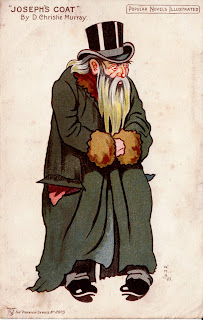
Joseph's coat

"Joseph's Coat" is a novel written by David Christie Murray, (1847–1907) was born in West Bromwich, Staffordshire, England. The novel was first published in 1880. While it shares its name with the biblical story of Joseph and his coat of many colors, the plot of Murray's novel is presumably not directly related to that biblical narrative.

Instead, "Joseph's Coat" is a social novel that deals with themes of identity, class, and society in late Victorian England. The story follows the life of Joseph Wilmot, a young man who faces various challenges and struggles as he navigates the complexities of English society. The novel explores Joseph's relationships, ambitions, and the societal pressures he encounters.

Apparently the title's reference to Joseph from the Bible is metaphorical rather than religious or ethnic. However, it's worth considering the historical context in which the novel was written. During the late 19th century, antisemitism was prevalent in Europe, including in England. Some authors of the time incorporated antisemitic stereotypes and sentiments into their works, reflecting the prejudices of the era.

The Illustration

The illustration does seem to show Jewish characteristics such as the huge nose and ears and the rather dirty looking coat, but perhaps that is my own view and not something intentional.

Deltiology


Artist: W. Milne Black
Publisher: William Lyon, Glasgow
Printer:
Date: 1903 (part of signature)
Printing Type:


Rarity: Common

#postcards #JewsAreDifferent

Wednesday, March 20, 2024

William Lyon, Glasgow, Scotland

William Lyon


Based in Glasgow, Scotland.


Born in 1845 in Troon, Ayrshire, William Lyon displayed early artistic talent. In 1867, following his marriage, he relocated to Glasgow. By 1868, he was listed as a stationer in the Post Office directory, expanding his services in 1869 to include die-sinking and crest embossing.

By 1871, Lyon's business had flourished, employing a staff of one man and nine girls in Sauchiehall Street. Over the years, Lyon's stationery enterprise continued to evolve. By 1885, he had established a presence with a shop at 389 Sauchiehall Street, a printing factory across the street at 474 Sauchiehall Street, and a retail branch in the Argyll Arcade.

Notably, Lyon revolutionized the stationery industry by introducing private Christmas cards, departing from the traditional slip-inset method. This innovation propelled demand, necessitating the expansion of Lyon's operations with the opening of his factory.

In 1888, Lyon showcased his diverse offerings, including visiting cards, at an exhibition, boasting a three-minute production service. By 1898, Lyon's commitment to progress was evident with the adoption of telephone communication at his factory.

Continuing to expand, Lyon operated four shops by 1900, strategically located across prime retail areas in Glasgow. In 1905, Lyon further consolidated his presence by establishing a shop at 177 Sauchiehall Street, later acquiring adjacent premises to form Lyon Corner.

By 1910, Lyon restructured his business as Lyon Ltd, entrusting its management to his eldest sons. Tragically, William Lyon passed away in 1913, leaving behind a legacy of innovation and entrepreneurial spirit.

In 1922, Lyon Ltd showcased its diverse range of products at the British Industries Fair, highlighting its premier series of cards, invitations, stationery, and silk pincushions, reflecting Lyon's enduring influence on the stationery and publishing industry.

For more information, see https://undividedbackpostcard.com/directory-l/#Lyon

Check these postcards from this publisher:
Joseph's coat
Joseph's Coar

W Milne Black

Not much is known about this Glasgow landscape artist. W Milne Black was known to have designed some comic postcards.

Statcounter