Showing posts with label Printer. Show all posts

Friday, October 24, 2025

Henderson Litho Company

Summary: Prominent Cincinnati color lithographer noted for posters, labels, and advertising work in the early 1900s. In 1925 the firm was acquired by the Strobridge Lithographing Company.

Henderson Lithographic Co.

postcard publisher mark

About the circled “H” postcard mark

A small H in a circle + 3-digit number appears on some American humor postcards circa 1905–1907. There is a reference here, which is widely accepted reference. 

Overview

Henderson Lithographic Company operated in Cincinnati with roots in Henderson–Achert and Henderson–Achert–Krebs partnerships. The company specialized in multicolor advertising lithography and occasionally issued postcards (documented examples appear in the 1910s).

Quick timeline

  • 1890s – Active in Cincinnati; lineage from earlier partnerships.
  • 1900s – Major producer of chromolithographed advertising; many jobs uncredited.
  • 1925 – Acquired by Strobridge Lithographing Company.

Postcards

Henderson is documented as a postcard printer in the 1900s. Earlier Cincinnati promotional mailers by Henderson also survive. Attribution lines are often absent, which was common for trade printers.


Related: A. Yerkes checklist

H 779 – “Vat! Somedings for Nodings”

Corrections or primary evidence welcome. If you have a card showing the circled-H mark and a printed Henderson credit, please share scans.

Working production model (1905–1907 humor cards)

  1. Concept/Art: A. Yerkes draws or scripts the gag.
  2. Publisher/Marketer: U.S. Novelty Co., Cincinnati, O. issues and distributes certain titles.
  3. Printer: Henderson Lithographic Co., Cincinnati prints the cards.

Why this model fits: Some cards bear a U.S. Novelty Co. line, Yerkes’s printed copyright, and a small ⓗ + number in the imprint area. The ⓗ device appears across multiple related comics and functions like a house series code.

Status: This is a well-supported hypothesis. To elevate it to “confirmed,” we seek a single card (or trade ad) that shows both a U.S. Novelty publisher line and the ⓗ-number, or a printer’s credit to Henderson on an H-series title.

Evidence table (specimens so far)

  • H 779 — “Vat! Somedings for Nodings” — front shows Copyright 1905 by A. Yerkes and ⓗ779; no publisher/ printer line visible on the example.
  • H 781 — “Von’t you be mein” — Yerkes credit + ⓗ781; mailed 1906; no publisher/ printer line on the example.
  • H 782 — “And he winked the other eye” — Yerkes credit + ⓗ782 (museum image); no publisher line noted in record.
  • H 836 — magician gag — ⓗ836 on front; no Yerkes credit; undivided back, mailed 1906.
  • U.S. Novelty Co.— separate examples exist with “Comic Series — U.S. Novelty Co., Cincinnati, O.” lines and Yerkes-style art; we’re looking for overlap with the ⓗ series.

Have a card that shows the U.S. Novelty line and the ⓗ-number together (or any Henderson credit)? Please share scans—those will lock the chain.


Wednesday, June 26, 2024

Colourpicture Publishers, Inc

Colourpicture Publishers, Inc. was a prominent publisher and printer of linen view cards in the United States. It was situated on Newbury Street with a factory at 76a Atherton Street. From 1938 to 1969, the company was based in Boston and Cambridge, Massachusetts.

In addition to linen view cards, they expanded their offerings in the 1950s to include photochromes and small spiral-bound picture booklets under the trade name Plastichrome

Wednesday, June 5, 2024

Eduard Buettner & Company

Eduard Buettner & Company a German postcard publisher based in Berlin. The company was active from 1880 until they closed their postcard publishing in 1906. Here are some key details about the company:
  • Inception: The company was established 1880
  • Dissolution: Closed their postcard business by mid 1906 and announced to concentrate on playing card production only. Huge stocks of cards and other items were on sale, incl. their latest postcard series, printing finished in Sept. 1906. Also all their presses and other equipment used for embossing, gilding etc. was for sale.
  • Products: Greetings cards & deluxe paper manufacturers, later also known for playing cards
  • Owners: Owners in 1898 were a Max Loewenstein and Ferd. Nagelschmidt
  • Address: Oranienburgerstr. 59, Berlin N.
  • Printing process: Early chromolithographic

The company's trademark was the initials E.B.& Co. i. B.(erlin) followed by the card/series number.

On Feb. 1, 1908 the entire Buettner & Co. playing card business was bought by their competitor and a leading playing card manufacturer  “Vereinigte Stralsunder Spielkartenfabriken AG”.
For more information, check here

Check these postcards from this publisher:
Three little Jewish pigs
Three little pigs

Tuesday, May 14, 2024

Emil Pinkau & Co

The Emil Pinkau Lithographic Art Institute was established on October 1, 1873, at 19 Brüderstraße, Leipzig. Initially focused on business printed materials, the company later expanded to include reproductions of old masters for art books and portfolios. By the late 1870s, the company had also begun specializing in postcards, making it one of the earliest manufacturers in this field.

Emil Pinkau (1850-1922) began with no capital, slowly equipping his factory over time. His first high-speed lithographic press was acquired in 1883. Pinkau worked tirelessly, both day and night, to build his business. The company’s growth necessitated several relocations starting in 1877. In 1898, a large new factory with its own railway connection was constructed at the corner of 15 Wittenberger Strasse and 13 Dessauer Strasse, which was further expanded in 1906 and 1910.

Pinkau quickly specialized in photolithographic views, initially producing Leporello albums, which are books of photographs in a concertina format. The high quality of Pinkau’s photolithographic work was recognized with the Grand State Prize for Leporello albums at the 1893 World Exhibition in Chicago.

The Lithographic Art Institute soon gained a reputation for its postcard printing. Pinkau was among the first to recognize the potential of this emerging mass medium. A 1911 letterhead advertised their specialty since 1879: large print runs of viewing postcards. Pinkau's focus remained on printing, as evidenced by the 1911 letterhead, which explicitly stated: "No publisher – only fabrication."

In 1902, Johannes Pinkau (1879-1958), Emil Pinkau’s eldest son, joined the company as technical manager, contributing significantly to innovations and advancements in the following years. By 1904, Pinkau had transformed his sole proprietorship into a stock corporation, Emil Pinkau & Co AG. In 1903, company letterheads noted 16 high-speed presses and 40 auxiliary machines, growing to 32 high-speed presses and 150 auxiliary machines by 1911. The workforce also expanded from 200 employees in 1904 to 450 in 1911.

In 1909, Dr. Trenkler & Co AG, a major competitor in the postcard industry, sold off its publishing division. By 1938, Emil Pinkau AG had claimed most of the profits from the Trenkler-Verlag.

For more information: TPA article 15

Thursday, May 9, 2024

Emil Köhn, Munich


Emil Köhn, a master of the printing craft, made his mark in Munich, Germany, in the waning years of the 19th century and the dawn of the 20th. His legacy, though not richly detailed in historical records, is anchored in the exceptional quality of his print work, with postcards being his notable forte. His company was also published as "Emil Köhn Noris" (= from Nürnberg/Nuremberg) or "Emil Köhn Nürnberg" at some time. His office in Munich was first at Elvirastr #2 then moved to Maria-Theresiastr, 16

At that time, Munich was a bustling nexus of artistic, cultural, and industrial activity, and the demand for printed works was high. Köhn's print shop was likely a linchpin in this milieu, adding to the city's effervescent cultural and economic fabric.

His collaboration with Ottmar Zieher, an esteemed figure in the postcard publishing realm, speaks volumes of Köhn's esteemed status in the printing community. His alliance with Zieher, who was famed for his postcard expertise, indicates Köhn's esteemed skill set and dependability in churning out attractive and marketable print pieces.

While the particulars of Köhn's imprint on the industry are scant, his name is still intertwined with Munich's spirited cultural tapestry of his time. His print work, especially the postcards that captured the essence of Munich's beer-centric social life, mirrors the confluence of business, creativity, and the local ethos prevalent in Munich during that epoch.

Here is an example (Check the original post here):


Check these postcards from this printer:
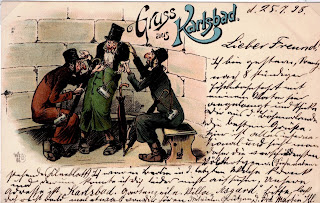
Jewish distorted bodies
"Gruss aus" series Distorted Bodies
Jews are dirty, Rebecca having a bath
Rebecca having a bath

Friday, May 3, 2024

Dexter Press, Inc

Dexter Press, Inc. was founded by Thomas A. Dexter in 1920 as a one-man operation in Pearl River, New York. It became renowned for its innovation and craftsmanship in postcard production. Notably, they were responsible for creating the first natural color postcard in 1932.

"Silvercraft" typically refers to items made from silver or silver-plated materials. Dexter Press, based in Pearl River, New York, was a well-known printing company that produced a wide range of items, including postcards. If you have a postcard with "Silvercraft - made by Dexter Press, Pearl River" on the back, it might indicate that the postcard was printed by Dexter Press and perhaps features an image or design related to silver craftsmanship. It could be a vintage or collectible postcard produced by the company.

Statcounter