Showing posts with label Jewish Look. Show all posts

Thursday, May 16, 2024

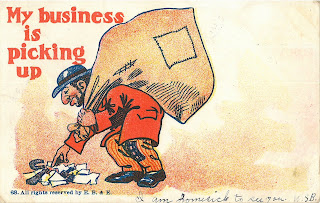
My business is picking up

Postcards from the early 20th century often reflected the prevailing attitudes and stereotypes of the time, including those related to ethnicity and religion. Unfortunately, anti-Semitic sentiments were not uncommon during this period, and derogatory depictions of Jews were sometimes used for humor or to perpetuate negative stereotypes.

Postcards with the image of a Jew picking up garbage accompanied by the text "my business is picking up," is an example of such derogatory imagery. The phrase "my business is picking up" is likely intended as a pun, playing on the idea of picking up garbage as a literal occupation and suggesting that this is somehow associated with being Jewish.

These kinds of images and messages were part of a broader trend of anti-Semitic propaganda and discrimination that Jews faced in many parts of the world during the early 20th century. While such imagery is offensive and harmful, it can also serve as a reminder of the persistence of prejudice and the importance of challenging stereotypes and promoting understanding and tolerance.

Deltiology

The copyright notice font (and sometimes the placement) could change between runs because it wasn’t part of the original artwork—it was usually typeset separately and added in the lithographic process.
Artist: 
Publisher: Ely, Boynton & Ely
Printer:
Date: (1903–1905)
In the early 1900s (1903–1905), italics were often used for fine-print legal phrases like “All rights reserved” — mimicking book-publishing practice.
Antisemitic postcard showing the Jews as cheap
Artist: 
Publisher: Ely, Boynton & Ely
Printer:
Date: 1906 - 1907, Postmarked 1907 (undivided back)
The copywrite notice shifted toward upright roman or bold sans-serif fonts, partly for legibility (these cards were mass-market items, unlike books). 
Antisemitic postcard showing the Jews as cheap
Artist: 
Publisher: Ely, Boynton & Ely
Printer:
Date: Probably 1908, divided back, postmarked 1910
Color variant of the first issue. Probably printed late 1907–08, when E. B. & E. were wrapping up operations. The use of the same italic copyright line shows that they recycled earlier stones rather than investing in new typesetting for their closing years
Antisemitic postcard showing the Jews as cheap
Artist: 
Publisher: International Postcard Company
Printer:
Type: Leather
Date: 1905 (Lewis and Clark Exposition in Portland)
Antisemitic postcard showing the Jews as cheap
Artist: 
Publisher: Adolph Selige Pub Co., St. Louis, Missouri
Printer:
Type: Regular
Date: 1905 - 1907 (Undivided back)
Antisemitic postcard showing the Jews as cheap


#postcards #JewsAreDifferent

Thursday, March 21, 2024

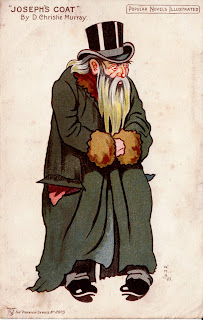
Joseph's coat

"Joseph's Coat" is a novel written by David Christie Murray, (1847–1907) was born in West Bromwich, Staffordshire, England. The novel was first published in 1880. While it shares its name with the biblical story of Joseph and his coat of many colors, the plot of Murray's novel is presumably not directly related to that biblical narrative.

Instead, "Joseph's Coat" is a social novel that deals with themes of identity, class, and society in late Victorian England. The story follows the life of Joseph Wilmot, a young man who faces various challenges and struggles as he navigates the complexities of English society. The novel explores Joseph's relationships, ambitions, and the societal pressures he encounters.

Apparently the title's reference to Joseph from the Bible is metaphorical rather than religious or ethnic. However, it's worth considering the historical context in which the novel was written. During the late 19th century, antisemitism was prevalent in Europe, including in England. Some authors of the time incorporated antisemitic stereotypes and sentiments into their works, reflecting the prejudices of the era.

The Illustration

The illustration does seem to show Jewish characteristics such as the huge nose and ears and the rather dirty looking coat, but perhaps that is my own view and not something intentional.

Deltiology


Artist: W. Milne Black
Publisher: William Lyon, Glasgow
Printer:
Date: 1903 (part of signature)
Printing Type:


Rarity: Common

#postcards #JewsAreDifferent

Thursday, September 21, 2023

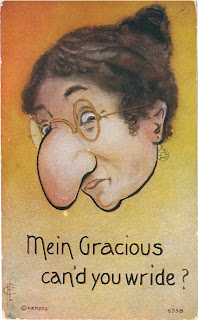
Mein gracious, can'd you wride

antisemitic postcard showing a woman with a huge nose and the sentiment 'mein gracious, can'd you wride'

A caricature of a woman with a huge Jewish nose which is out of propertion with her features. Also shows Yiddish accented English, 'mein gracious, can'd you wride'. This displays the stereotype of a Jew with a huge nose as well as not being able to speak English properly.

What is the Jewish nose or the Hooked nose

The term 'Jewish nose' or 'hooked nose' is a harmful stereotype perpetuating a perceived physical trait associated with some Jewish individuals, suggesting a prominent or curved nose shape. However, it's crucial to emphasize that stereotypes are inaccurate and offensive. Stereotypes only fuel prejudice, discrimination, and bias. Jewish people, like any other group, display a diverse range of physical characteristics. It's essential to promote understanding and respect for diversity rather than perpetuating harmful assumptions based on physical appearances. Stereotypes have no basis in science or fact and should be actively discouraged and challenged.

Deltiology

Artist: Frederick Leopold Cavally
Publisher: F.A. Moss
Printer:
Date: 1909

Part of the F.A Moss reminder series 6538

Rarity: ☝☝☝ less than ten seen by this blogger

#postcards #JewsAreDifferent #comic #JewishNose #jewNose

Thursday, August 17, 2023

Something for Nothing

Antisemitic postcard showing an evil looking Jewish stereotype
The postcard says: "Vat! Somedings for Nodings".
The Jew is made to look evil and cheap!

The stereotype of a 'Jewish accent'

The stereotype of a 'Jewish accent,' characterized by distinct pronunciations and language adaptations, has roots in historical immigration and language transition. Over time, these linguistic traits may have been exaggerated or misrepresented in popular culture, perpetuating a harmful stereotype. This stereotype emerged as Jewish immigrants and their descendants embraced English as a second language while maintaining aspects of their native tongues. Unfortunately, these caricatures have been used in media, entertainment, and literature, contributing to prejudiced perceptions. It's crucial to challenge and dispel stereotypes, fostering understanding and promoting a more inclusive society that appreciates diversity and values individuals for who they are.

The stereotype of a Jew being evil

The harmful stereotype of Jewish people being evil or untrustworthy has deep-rooted origins in centuries of anti-Semitism, prejudice, and discriminatory beliefs. Anti-Semitism, which is hostility, prejudice, or discrimination against Jewish people, has a long and unfortunate history, dating back over two thousand years.
Throughout history, Jews have often been scapegoated and blamed for various societal issues, economic problems, and political unrest. In medieval Europe, for instance, false accusations were made against Jews, such as the blood libel (accusations of Jews using Christian blood in religious rituals) and the spreading of harmful myths about their supposed malevolent influence.
During the Middle Ages, when Christians were forbidden by the Church from engaging in money lending due to usury laws, Jews were permitted to participate in money lending. As a result, they became associated with financial transactions, further perpetuating stereotypes about greed and untrustworthiness.

Deltiology

Artist: Alfred N. Yerkes
Publisher: Henderson Litho Company
Printer:
Date: 1905 (Undivided back era)
From A. Yerkes Series 779
This card is a collaboration between A. Yerkes and the Henderson Litho Company.
Rarity: ☝ Not common

#postcards #stereotype #JewishLook

Wednesday, August 16, 2023

Scholem Alechum

The card says: "Scholem Alechum" or "Peace be with you". It shows two Jews fighting, pulling at their beards.
This is the stereotype of a Jew with large noses, wearing different coats and sidelocks.

Artist:
Publisher: National Comic Postal Card Company.
Printer:
Date: 1905 (Undivided back era)
Rarity: ☝☝ Difficult to Find

May your troubles be little ones

The card says: Mazel, Broche und a grosse mispoche". The card shows an image of a family with many children, all ugly with the same deformed face with hook noses and shabbily dressed.
This is the stereotype of a Jew that they have a large family and only speak Yiddish.

Artist:
Publisher: National Comic Postal Card Company.
Printer:
Date: 1905 (Undivided back era)
Rarity: ☝ Not common

Ach, Weh is Mir

The card says: "Ach, Weh is Mir", "What a misfortune" (tranlation) showing an ugly, disformed Jewish woman with an overturned food basket.
This is the stereotype of a Jew that they only speak Yiddish.

Artist:
Publisher: National Comic Postal Card Company.
Printer:
Date: 1905 (Undivided back era)

Rarity: ☝ ☝ Difficult to Find

Tuesday, August 15, 2023

Horse wearing sidelocks

Artist prepared an artwork series showing different stereotypes as animals. For a Jew he used the skullcap and prominent sidelocks (or payot)

Sidelocks in English, or payot in Hebrew, are worn by some men and boys in the Ultra Orthodox Jewish community and is based on an interpretation of Jewish law's injunction against shaving the sides of one's head.

Artist: Arthur Thiele
Publisher: Theodor Ströfer
Printer:
Date:
From series 1215 of “Horse Gentlemen”
Rarity: ☝☝☝ (less than three seen by this blogger)


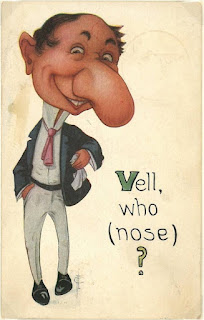
Vel, who nose?

antisemitic postcard showing a man with a huge nose

A caricature of a Jewish nose which is huge in comparison to the face. Also shows Yiddish accented English, a play on "Well, who knows?"

What is the Jewish nose or the Hooked nose

The term 'Jewish nose' or 'hooked nose' is a harmful stereotype perpetuating a perceived physical trait associated with some Jewish individuals, suggesting a prominent or curved nose shape. However, it's crucial to emphasize that stereotypes are inaccurate and offensive. Stereotypes only fuel prejudice, discrimination, and bias. Jewish people, like any other group, display a diverse range of physical characteristics. It's essential to promote understanding and respect for diversity rather than perpetuating harmful assumptions based on physical appearances. Stereotypes have no basis in science or fact and should be actively discouraged and challenged.

Deltiology


Artist: Frederick Leopold Cavally
Publisher:
Printer:
Date: Postmarked 1912


Rarity: ☝☝☝ less than ten seen by this blogger

#postcards #JewsAreDifferent #comic

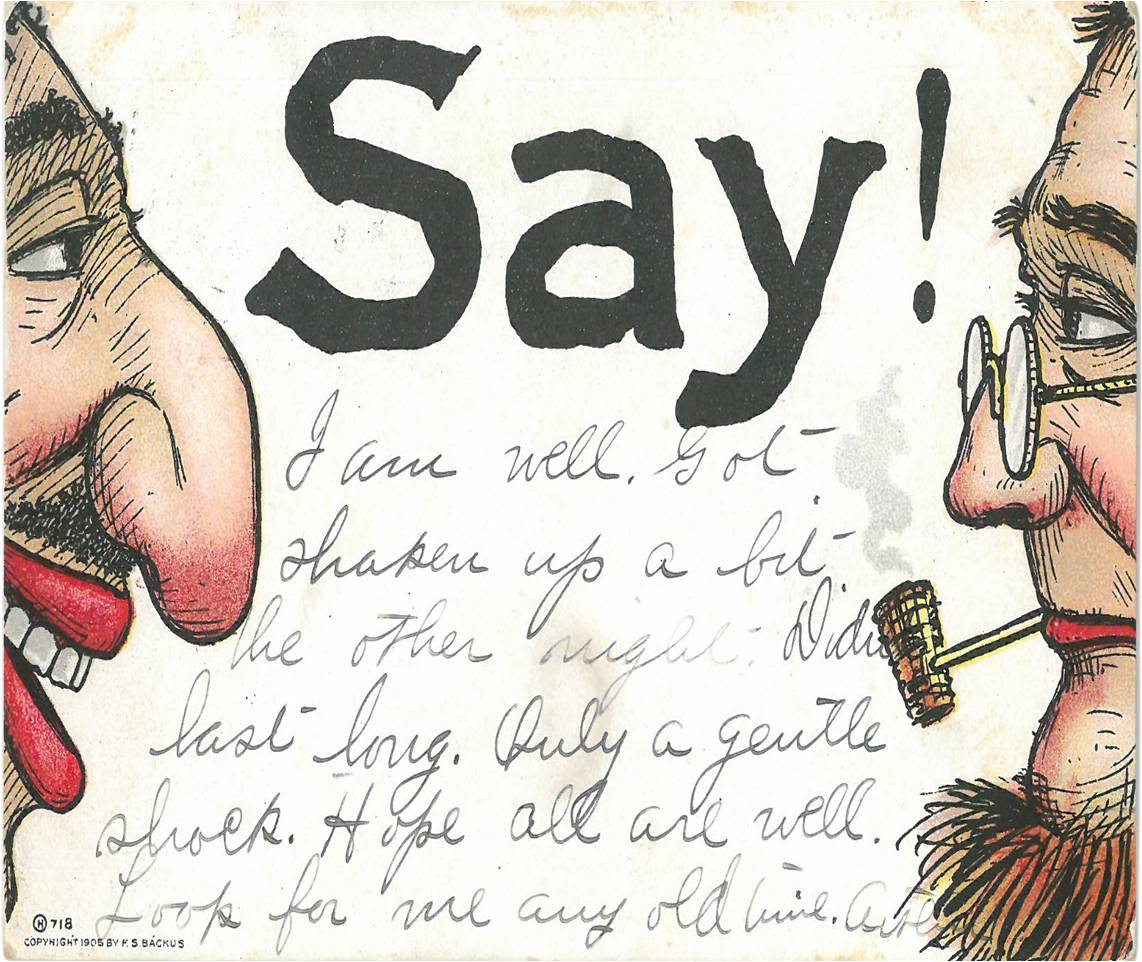
Say!

Antisemitic postcard showing a man with a hooked nose

Shows the ultimate stereotype of the Jewish nose. It is a hooked nose with a downward turn of the tip of the nose. The 'Jewish nose' was singled out as a hostile caricature of Jews in mid-13th century Europe. Since the 18th century it has become the rule when showing what a Jew looks like.

What is the Jewish nose or the Hooked nose

The term 'Jewish nose' or 'hooked nose' is a harmful stereotype perpetuating a perceived physical trait associated with some Jewish individuals, suggesting a prominent or curved nose shape. However, it's crucial to emphasize that stereotypes are inaccurate and offensive. Stereotypes only fuel prejudice, discrimination, and bias. Jewish people, like any other group, display a diverse range of physical characteristics. It's essential to promote understanding and respect for diversity rather than perpetuating harmful assumptions based on physical appearances. Stereotypes have no basis in science or fact and should be actively discouraged and challenged.

Deltiology


Artist:
Publisher: F. S. Backus
Printer:
Date: 1905
From series 718 of “Say!” Each postcard in the series showed two different stereotypes.

Rarity: ☝☝☝☝ less than three seen by this blogger

Statcounter