Showing posts with label Accent. Show all posts

Friday, July 26, 2024

Belief me

Belief Me – A.H. Jewish stereotype postcard

Author: Lawrence –

Location: Chicago, Illinois, USA

These four postcard variants, and probably more exist, all showing the same caricatured image, were printed across different years. Each reflects the commercial humor and visual style of the early postcard era, with subtle differences in production or captioning.

Series overview: The caption Belief Me appears on a group of early 1900s postcards credited as Copyright 1905 – A.H., likely tied to Alfred Holzman of Chicago. Designs exist as paper chromolithographs and as leather postcards burned by pyrography. Numbering of 73, in the lower margin places them, in a commercial humor series from the undivided back era.

Antisemitic Stereotypes Depicted

This postcard features a number of classic antisemitic stereotypes that were commonly used in early 20th-century European and American visual culture. The image and text employ caricature and symbolism to perpetuate harmful, false depictions of Jews, which were typical in period postcards and other forms of popular media.
  • Physical Caricature: The man is depicted with exaggerated facial features—large nose, thick lips, and round spectacles—traits that have been used in antisemitic iconography to mock Jewish appearance.
  • Attire: The figure wears a beard and a skullcap, suggesting the stereotype of the "Eastern European Jew" or Orthodox Jew, feeding into the imagery used to otherize Jewish communities.
  • Jewelry: The prominent jewel or medallion on the chest can be linked to stereotypes about Jews and wealth or greed, with the radiant lines around the stone possibly suggesting ostentatiousness or material obsession.
  • Smoking Cigar: The smoking cigar, often seen in antisemitic illustrations, can be intended to indicate self-indulgence, showiness, or a louche lifestyle.
  • Gestures: The open-handed gesture might be interpreted as a sign of exaggerated speech or persuasion, often used to suggest untrustworthiness or theatricality in antisemitic portrayals.
  • Text (“Belief Me”): The pseudo-Germanic phrase “Belief Me,” intentionally misspelled, mocks Jewish accent or manner of speaking, a trope found in English-language antisemitic humor at the time.

Production notes

  • Credit line in first postcard reads Copyright 1905 – A.H. with a small series number of 73.
  • Printed as chromolithography on paper and as leather postcards using pyrography on deer hide.

Why classify Belief Me as antisemitic?

The humor is built from caricatured features, religious costume cues, wealth markers, and mock accent spelling that invite readers to see Jewishness as comic and untrustworthy.

Belief Me postcard, 1905
Variant 1: Original chromolithograph edition (1905)
Variant 2
Variant 2: Leather pyrography version (1905)

Variant 3
Variant 3: Leather postcard with green shirt (1905)
Variant 4
Variant 4: No copyright (1907), divided back period

Thursday, August 17, 2023

Something for Nothing

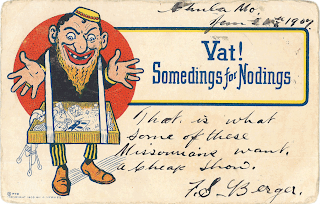
Antisemitic postcard showing an evil looking Jewish stereotype
The postcard says: "Vat! Somedings for Nodings".
The Jew is made to look evil and cheap!

The stereotype of a 'Jewish accent'

The stereotype of a 'Jewish accent,' characterized by distinct pronunciations and language adaptations, has roots in historical immigration and language transition. Over time, these linguistic traits may have been exaggerated or misrepresented in popular culture, perpetuating a harmful stereotype. This stereotype emerged as Jewish immigrants and their descendants embraced English as a second language while maintaining aspects of their native tongues. Unfortunately, these caricatures have been used in media, entertainment, and literature, contributing to prejudiced perceptions. It's crucial to challenge and dispel stereotypes, fostering understanding and promoting a more inclusive society that appreciates diversity and values individuals for who they are.

The stereotype of a Jew being evil

The harmful stereotype of Jewish people being evil or untrustworthy has deep-rooted origins in centuries of anti-Semitism, prejudice, and discriminatory beliefs. Anti-Semitism, which is hostility, prejudice, or discrimination against Jewish people, has a long and unfortunate history, dating back over two thousand years.
Throughout history, Jews have often been scapegoated and blamed for various societal issues, economic problems, and political unrest. In medieval Europe, for instance, false accusations were made against Jews, such as the blood libel (accusations of Jews using Christian blood in religious rituals) and the spreading of harmful myths about their supposed malevolent influence.
During the Middle Ages, when Christians were forbidden by the Church from engaging in money lending due to usury laws, Jews were permitted to participate in money lending. As a result, they became associated with financial transactions, further perpetuating stereotypes about greed and untrustworthiness.

Deltiology

Artist: Alfred N. Yerkes
Publisher: Henderson Litho Company
Printer:
Date: 1905 (Undivided back era)
From A. Yerkes Series 779
This card is a collaboration between A. Yerkes and the Henderson Litho Company.
Rarity: ☝ Not common

#postcards #stereotype #JewishLook

Wednesday, August 16, 2023

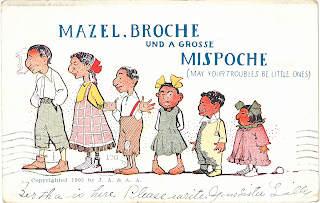
May your troubles be little ones

The card says: Mazel, Broche und a grosse mispoche". The card shows an image of a family with many children, all ugly with the same deformed face with hook noses and shabbily dressed.
This is the stereotype of a Jew that they have a large family and only speak Yiddish.

Artist:
Publisher: National Comic Postal Card Company.
Printer:
Date: 1905 (Undivided back era)
Rarity: ☝ Not common

Tuesday, August 15, 2023

Goldfish as a gift

Goldfish as a gift

Postcard Description

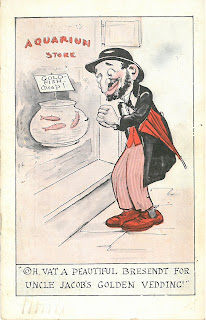
"OH vat a peautiful bresendt for Uncle Jacob's golden vedding"

This early 20th-century postcard depicts a Jewish character presenting a goldfish in a bowl as a wedding gift, with the caption written in phonetic Yiddish-accented English.

Vintage postcard showing Jewish man with goldfish gift for golden wedding, published by Taylor Platt Company 1916

Stereotype Theme: Jewish Cheapness

This postcard exemplifies the "cheap Jew" stereotype, one of the most persistent antisemitic tropes in early 20th-century popular culture. The humor relies on a pun between "golden wedding" (50th anniversary) and a literal "gold fish" - suggesting the Jewish character is too cheap to buy an appropriate gift.

Important distinction: The "cheap" stereotype differs from the "greedy" stereotype. While greed implies hoarding wealth, cheapness suggests unwillingness to spend money even when appropriate. Both were common themes in Jewish stereotype postcards.

Linguistic Stereotype

The phonetic spelling ("vat," "peautiful," "bresendt," "vedding") mocks Yiddish pronunciation patterns, representing the "w" as "v" and "th" as "t" sounds. This linguistic caricature was common in early 1900s postcards depicting Jewish immigrants.

Publisher Information

Publisher: Taylor, Platt & Co.

Taylor, Platt & Company was a New York-based postcard publisher (1906-1916) located at 1161 Broadway. They specialized in comic postcards, including numerous cards featuring Jewish stereotypes with exaggerated dialects and physical features.

Postcard Details

Date: Postmarked 1916
Artist: Unknown
Printer: Unknown
Rarity: ☝☝ (not common)

Historical Context

This postcard was produced during the "Golden Age" of postcards (1905-1915) when millions of comic and stereotype postcards circulated in the United States. Jewish-themed cards were part of a broader trend of ethnic humor postcards targeting various immigrant groups.

Related Posts

Statcounter