Showing posts with label Postcards. Show all posts

Thursday, September 25, 2025

Highlander frae Jee-rusalem

Antisemitic postcards from the early 20th century provide a disturbing window into how Jewish stereotypes were normalized in popular culture. The 1909 Bamforth comic postcard exemplifies how these harmful caricatures were mass-produced and distributed as "entertainment," contributing to the perpetuation of antisemitic attitudes across society.

The 1909 Bamforth Postcard: Visual Analysis

Front Image: Dissecting the Antisemitic Imagery

The front of this Bamforth postcard presents a grotesque caricature that embodies multiple antisemitic stereotypes prevalent in 1909. The illustration features an exaggerated male figure with distinctly antisemitic visual tropes:

  • Exaggerated facial features: The oversized hooked nose was a common antisemitic stereotype falsely linked to Jewish people.
  • Clothing and appearance: The figure is dressed in clothing suggesting both poverty and merchant activity, reinforcing stereotypes about Jewish economic roles.
  • Body language and posture: The character's stance and expression convey cunning or scheming, echoing harmful stereotypes about Jewish character.

Deltiology

  • Publisher identification: Bamforth & Co., a leading British postcard publisher of comic and novelty cards.
  • Series information: This postcard belonged to a broader series, showing systematic production rather than isolated creation.
  • Published: 1909

Historical Context: Britain in 1909

The Golden Age of Postcards

The period from 1900–1915 is often called the "Golden Age of Postcards." During this time:

  • Postcard collecting became a widespread hobby across social classes.
  • Publishers produced millions of cards on nearly every topic imaginable.
  • Comic postcards were especially popular, often relying on ethnic and social stereotypes.
  • Antisemitic imagery was unfortunately common and considered acceptable by society.

British Antisemitism in the Edwardian Era

In 1909, Britain experienced:

  • Increased Jewish immigration from Eastern Europe after pogroms.
  • Growing tensions about immigration and economic competition.
  • The normalization of antisemitic attitudes in popular culture.
  • A lack of legal protections against discriminatory content.

The Business of Stereotypes

For publishers like Bamforth, antisemitic postcards were:

  • Profitable products with an eager market.
  • Regarded as socially acceptable "humor."
  • Often part of larger series targeting different ethnic groups.
  • Normalized further by mass production and circulation.

The Role of Postcards in Normalizing Antisemitism

Mass Media and Social Attitudes

Postcards functioned as an early form of mass media that:

  • Crossed class and geographic boundaries.
  • Reinforced prejudices through repetition.
  • Framed antisemitic imagery as humorous or harmless.
  • Encouraged the casual acceptance of discrimination.

The Cumulative Effect

Widespread circulation of such postcards:

  • Normalized antisemitic stereotypes in daily life.
  • Targeted Jewish individuals for prejudice and ridicule.
  • Created a cultural climate that paved the way for later persecution.
  • Shows how “entertainment” can perpetuate serious social harm.

Collecting and Understanding Today

The Importance of Historical Documentation

Today, these postcards serve as:

  • Educational tools that reveal historical antisemitism.
  • Research material for scholars studying prejudice.
  • Warning signs of how hatred becomes normalized.
  • Context for understanding the roots of modern antisemitism.

Ethical Considerations for Collectors

Collectors should:

  • Handle materials with sensitivity.
  • Understand the historical harm they represent.
  • Prioritize education over profit.
  • Acknowledge their real-world impact on Jewish communities.

The Legacy of Antisemitic Postcards

From Postcards to Propaganda

The casual antisemitism of 1909 postcards foreshadowed:

  • More organized antisemitic propaganda in later decades.
  • The escalation from prejudice to legal discrimination.
  • The role of media in dehumanizing Jewish people.
  • The dangerous progression from stereotypes to persecution.

Lessons for Today

This Bamforth postcard illustrates:

  • How easily harmful stereotypes spread in society.
  • The power of mass media in shaping attitudes.
  • The need to recognize and challenge prejudice early.
  • The importance of vigilance against antisemitism today.

Frequently Asked Questions (FAQ)

What made Bamforth postcards so popular in 1909?

Bamforth postcards were affordable, widely available, and reflected contemporary humor. Skilled artists and efficient production made them accessible across social classes during the postcard craze of the early 1900s.

Were antisemitic postcards legal in Britain in 1909?

Yes. Britain had no hate speech or anti-discrimination laws in 1909, so publishers could freely produce and distribute antisemitic content.

How common were Jewish stereotype postcards in the early 1900s?

They were unfortunately very common. Major publishers included antisemitic cards in their comic series, sold widely in Britain and across Europe.

What happened to Bamforth & Co.?

Bamforth & Co. continued operating into the 20th century. While they later moved away from overtly antisemitic content, the company remained a major producer of comic postcards.

Why is it important to study these offensive postcards today?

Studying them helps us understand how prejudice was normalized, provides evidence of antisemitism in history, and highlights the power of media to spread harmful stereotypes. This knowledge is essential for preventing future repetition.

How should museums and collectors handle antisemitic postcards?

They should provide context, use the material for education, and present it with sensitivity to the harm it caused, rather than as curiosities or entertainment.

Conclusion: Understanding History to Prevent Repetition

The 1909 Bamforth postcard is more than a historical curiosity—it is evidence of how antisemitic stereotypes permeated popular culture as mass entertainment. Studying such artifacts reveals how prejudice operates and spreads across society.

These postcards remind us that antisemitism was not confined to extremists; it was woven into everyday life. Its casual nature made it especially dangerous, laying cultural groundwork for future persecution.

Saturday, September 20, 2025

Shylock - Merchant of Venice

Shylock Postcard (1906) – Antisemitic Shakespeare Illustration

This early 20th-century leather postcard illustrates Shylock, the Jewish moneylender from Shakespeare’s Merchant of Venice.  it reflects both the popularity of novelty postcards and the persistence of antisemitic stereotypes in American culture.

Front of 1906 Shylock antisemitic postcard showing caricature of Jewish figure from Shakespeare’s Merchant of Venice

The front of the card shows a caricature of Shylock with exaggerated features, clutching what appear to be moneybags. The caption reads Shakespeare Illustrated – The Merchant of Venice, ‘Shylock’. The border mimics a cut-out pattern, a common style in cheap comic postcards of the period.

Antisemitic Imagery

While the card presents itself as a “literary” illustration, it trades on longstanding antisemitic stereotypes:

  • Shylock is drawn with a hooked nose and hunched stance.
  • He is shown obsessing over money, echoing the trope of the greedy Jewish usurer.
  • The cartoon format reduces Shakespeare’s complex character into a crude stereotype, perpetuating cultural prejudice.

Postmark and Usage

Date: September 19, 1906 (Allegheny, PA, 4:30 PM). Allegheny City was annexed by Pittsburgh in 1907.
Stamp: 1¢ Benjamin Franklin definitive
Recipient: Miss Anna Disher, Erie, PA

Publisher

No publisher imprint is visible. This was likely produced by Knickerbocker Leather & Novelty Company (New York) in 1906.


The following video is a performance of Shylock's famous "Hath not a Jew eyes?" speech from The Merchant of Venice, which provides context for the character on the postcard.


Saturday, August 30, 2025

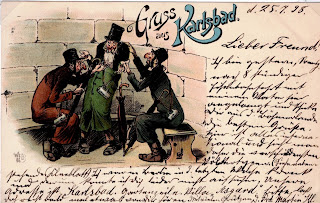
“Gruss aus Karlsbad” and toilet humor

“Gruss aus Karlsbad” – Toilet Humor and the Jewish Stereotype

Comic postcard, Karlsbad, ca. 1905–1910, probably published by Lederer & Popper, Prague

What is shown on this postcard?

This comic postcard, inscribed “Gruss aus Karlsbad” (“Greetings from Karlsbad”) today known as Karlovy Vary, depicts men and women queuing outside the toilets in desperation. The scene includes:

  • A humorous verse about the effects of drinking spa waters.
  • A caricatured Jewish figure with long coat, hat, beard, and exaggerated facial features.
  • Toilet humor combined with antisemitic stereotypes.

Who published it?

  • Likely publisher: Lederer & Popper, Prague.
  • Date: ca. 1905–1910.
  • Why this attribution? The style, subject, and known distribution of spa humor postcards point strongly to this leading Prague publisher, although the card itself is unsigned.

Why is this postcard antisemitic?

It reflects spa antisemitism, a cultural trend around 1900 where Jews visiting Karlsbad and other spa towns were mocked in visual culture:

  • Jews were frequent spa visitors.
  • Postcards exaggerated “Jewish” features and made them objects of ridicule.
  • Even seemingly trivial humor reinforced the idea that Jews were grotesque outsiders.

Deltiology

  • Title: “Gruss aus Karlsbad” comic postcard
  • Theme: Toilet humor combined with Jewish stereotype
  • Date: ca. 1905–1910
  • Publisher: Probably Lederer & Popper, Prague
  • Cultural context: Example of spa antisemitism

Why does this matter today?

Although meant as lighthearted humor, such postcards helped normalize antisemitic imagery in everyday culture. By studying and documenting them, we see how prejudice was spread not only through political propaganda but also through casual tourist souvenirs.

Answer Engine Optimization (Quick Summary)

This postcard from ca. 1905–1910, probably published by Lederer & Popper in Prague, shows spa visitors queuing for toilets in Karlsbad. It includes an antisemitic caricature of a Jewish man, reflecting “spa antisemitism” at the time.


Disclaimer

This post documents historic antisemitism in postcards. The descriptions and analysis are for educational and research purposes only. We do not endorse the imagery or the prejudices it reflects.


Thursday, August 28, 2025

Ahasver at the Deutscher Krug

Ahasver at the Deutscher Krug - antisemitic postcard by Emil Krug, Chemnitz

Lower margin imprint reads: Nachdruck verboten: Emil Krug, Chemnitz. Verlag von Emil Krug, Chemnitz.

This card frames the Jew as "the stranger" to be expelled. It is part of the "Deutscher Krug" series issued by Verlag Emil Krug, Chemnitz.

What the card shows

  • Figure label: Ahasver (Wandering Jew) - the eternal outsider.
  • Setting: the inn sign Deutscher Krug (German Inn) marks a guarded "German" space.
  • Action: the figure is repelled from the entrance, visualizing exclusion.

Printed caption and meaning

Da warf der Hausknecht aus Nubierland den Fremden vor die Thür. Frei nach Scheffel.
  • Fremden means "stranger" and refers to the Jewish figure.
  • Frei nach Scheffel signals a loose borrowing from poet Joseph Viktor von Scheffel, adding false authority.
  • Nubierland adds a mocking "exotic" touch that heightens othering.

Antisemitic attributes to document

  1. Label Ahasver equals the Wandering Jew stereotype.
  2. Expulsion scene at a place named "German Inn".
  3. Verse defines the Jew as the "stranger" to be thrown out.
  4. Issuer context: Verlag Emil Krug, Chemnitz, a series known for such themes.

Provenance and identification

  • Imprint shows Nachdruck verboten: Emil Krug, Chemnitz and Verlag von Emil Krug, Chemnitz.
  • Artwork includes the Deutscher Krug inn sign.
  • Caption uses the "Frei nach ..." formula naming Scheffel.

Deltiology

Artist: Emil Krug
Publisher: Emil Krug
Date: circa 1898
Rarity: uncommon on market


Disclaimer

This post documents historic antisemitism in postcards. The descriptions and analysis are for educational and research purposes only. We do not endorse the imagery or the prejudices it reflects.


Friday, July 26, 2024

Belief me

Belief Me – A.H. Jewish stereotype postcard

Author: Lawrence –

Location: Chicago, Illinois, USA

These four postcard variants, and probably more exist, all showing the same caricatured image, were printed across different years. Each reflects the commercial humor and visual style of the early postcard era, with subtle differences in production or captioning.

Series overview: The caption Belief Me appears on a group of early 1900s postcards credited as Copyright 1905 – A.H., likely tied to Alfred Holzman of Chicago. Designs exist as paper chromolithographs and as leather postcards burned by pyrography. Numbering of 73, in the lower margin places them, in a commercial humor series from the undivided back era.

Antisemitic Stereotypes Depicted

This postcard features a number of classic antisemitic stereotypes that were commonly used in early 20th-century European and American visual culture. The image and text employ caricature and symbolism to perpetuate harmful, false depictions of Jews, which were typical in period postcards and other forms of popular media.
  • Physical Caricature: The man is depicted with exaggerated facial features—large nose, thick lips, and round spectacles—traits that have been used in antisemitic iconography to mock Jewish appearance.
  • Attire: The figure wears a beard and a skullcap, suggesting the stereotype of the "Eastern European Jew" or Orthodox Jew, feeding into the imagery used to otherize Jewish communities.
  • Jewelry: The prominent jewel or medallion on the chest can be linked to stereotypes about Jews and wealth or greed, with the radiant lines around the stone possibly suggesting ostentatiousness or material obsession.
  • Smoking Cigar: The smoking cigar, often seen in antisemitic illustrations, can be intended to indicate self-indulgence, showiness, or a louche lifestyle.
  • Gestures: The open-handed gesture might be interpreted as a sign of exaggerated speech or persuasion, often used to suggest untrustworthiness or theatricality in antisemitic portrayals.
  • Text (“Belief Me”): The pseudo-Germanic phrase “Belief Me,” intentionally misspelled, mocks Jewish accent or manner of speaking, a trope found in English-language antisemitic humor at the time.

Production notes

  • Credit line in first postcard reads Copyright 1905 – A.H. with a small series number of 73.
  • Printed as chromolithography on paper and as leather postcards using pyrography on deer hide.

Why classify Belief Me as antisemitic?

The humor is built from caricatured features, religious costume cues, wealth markers, and mock accent spelling that invite readers to see Jewishness as comic and untrustworthy.

Belief Me postcard, 1905
Variant 1: Original chromolithograph edition (1905)
Variant 2
Variant 2: Leather pyrography version (1905)

Variant 3
Variant 3: Leather postcard with green shirt (1905)
Variant 4
Variant 4: No copyright (1907), divided back period

Wednesday, July 3, 2024

Abbie the Agent

Harry Hershfield brainchild of "Abie the Agent," debuted in 1914 and featured a Jewish car salesman named Abie Kabibble. The strip was one of the first in American comics to prominently feature a Jewish character and to explore themes relevant to the Jewish-American experience. These were known as Kabibble Cards.

The postcards featured humorous illustrations and captions, often depicting Jewish stereotypes in a light-hearted and affectionate manner. 

They played on common themes and situations familiar to many in the Jewish community. These cards were popular in the early 20th century, reflecting the humor and social attitudes of the time. They were part of a broader trend of comic and humorous postcards that were widely collected and exchanged.

Deltiology


Artist: Harry Hershfield
Publisher: Illustrated Post Card & Novelty Co
Date: Postmark 1914


Rarity: ☝

Wednesday, June 26, 2024

The Arnold

The Arnold Hotel of Miami Beach, Florida was situated by the ocean at 86th Street.

Most exclusive in the North Beach section of Miami Beach, also with a private beach, but more importantly, only Gentile Clientele.

Harry A. Brown was the owner of the hotel and in November 1942 agreed to rent the entire hotel to the army. I wonder what would happen if he found any Jews amongst the soldiers.

Deltiology


Artist: Taken from a photograph
Publisher: Colourpicture Publishers, Inc
Date: Postmark 1942
Printing Method: Linen Postcard


Rarity: ☝ Common

Tuesday, June 25, 2024

Falmouth Associates


Falmouth Associates, The Moors, Falmouth, Cape Cod, Massachusetts A Carefully Restricted Community With golf, tennis, boating and bathing.

The Moors was an exclusive community that prohibited the sale of property to Jewish individuals. It consisted of 60 homes located in and around Elm Road in Falmouth. The community association was established in 1925 and offers a variety of amenities including a clubhouse, two tennis courts, 12-acres of open space, private beach on Vineyard Sound, beach house and a diving raft. 

The Moors community schedules numerous social events in the summer months!

The Moors community was developed in the early 20th century, a time when Cape Cod was becoming a popular destination for affluent families seeking summer residences. The community was planned and established to cater to an exclusive clientele, with an emphasis on maintaining a certain social and economic status among its residents.

Deltiology


Artist: Taken from a photograph
Publisher: Tichnor Quality Views
Printer:
Date: Circa 1925
Printing Method: Process Printing


Rarity: ☝ Common

Thursday, June 20, 2024

I've been poisoned

Jews shown as pigs
Postcard with a printed image of a two people speaking with a seeming Yiddish accent. 

It seems that one person confesses on his death bed that he swindled the other and the other obviously knew because he is the one who poisoned him.

Stereotype of betrayal and untrustworthiness

Artist: Stanley Herbert, S.H.
Publisher: Hutson Brothers Ltd
Printer: Hutson Brothers Ltd
Printing Process: Chromolithography
Date: circa 1930

Rarity: ☝☝ Common

#postcards #stereotype


Thursday, June 6, 2024

Three Little Pigs

Jews shown as pigs
Postcard with a printed image of three clothed pigs seated on a bench. They have stereotypical Jewish features, including curled payot and protruding noses. 

In Jewish religious texts, pigs symbolize filth and abomination, and Judaism forbids the consumption of pork. The portrayal of the Jewish men as pigs was a deriding twist on the classic caricature of three Jews on a bench. The text says:
Look at the card in a friendly way! Each one of these three are linked to your desires, you have the right lucky pig.

One function of such “humorous” caricatures was to render the other or the (possible) opponent /rival ridiculous

Artist:
Publisher: Eduard Buettner & Company
Printer: Eduard Buettner & Company
Printing Process: Chromolithography
Date: circa 1899

Rarity: ☝☝☝☝☝ Very rare and very expensive

#postcards #stereotype #Unwelcome #kolner_Hof

Friday, May 31, 2024

Hotel Kölner Hof - Jews wander for 40 years #1

Hotel Kölner Hof
Hotel Kölner Hof printed a series of cards. It prided itself on being a hotel without Jews. Read about it here.

This postcard depicts the arrival of a Jewish caravan from the desert. The text says:
Moses You acted badly when God gave you power. You mistreated the great people for 40 years at Sinai. Without shelter, you led them around like rabbits, with your beautiful noses, so that they all became crooked. But these evil deeds have taken revenge on you, God the Father then said to you: You must die, evil one, (real"! (Continuation Card No. 2)


Artist:
Publisher: Kolner Hof
Printer:
Printing Process: Chromolithography
Date: circa 1900

Rarity: ☝☝☝ ☝ Expensive but does appear in auctions

#postcards #stereotype #Unwelcome #kolner_Hof

Thursday, May 16, 2024

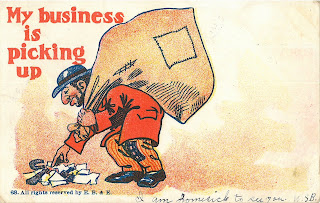
My business is picking up

Postcards from the early 20th century often reflected the prevailing attitudes and stereotypes of the time, including those related to ethnicity and religion. Unfortunately, anti-Semitic sentiments were not uncommon during this period, and derogatory depictions of Jews were sometimes used for humor or to perpetuate negative stereotypes.
Postcards with the image of a Jew picking up garbage accompanied by the text "my business is picking up," is an example of such derogatory imagery. The phrase "my business is picking up" is likely intended as a pun, playing on the idea of picking up garbage as a literal occupation and suggesting that this is somehow associated with being Jewish.

These kinds of images and messages were part of a broader trend of anti-Semitic propaganda and discrimination that Jews faced in many parts of the world during the early 20th century. While such imagery is offensive and harmful, it can also serve as a reminder of the persistence of prejudice and the importance of challenging stereotypes and promoting understanding and tolerance.

Deltiology

The copyright notice font (and sometimes the placement) could change between runs because it wasn’t part of the original artwork—it was usually typeset separately and added in the lithographic process.
Artist: 
Publisher: Ely, Boynton & Ely
Printer:
Date: (1903–1905)
In the early 1900s (1903–1905), italics were often used for fine-print legal phrases like “All rights reserved” — mimicking book-publishing practice.
Antisemitic postcard showing the Jews as cheap
Artist: 
Publisher: Ely, Boynton & Ely
Printer:
Date: 1906 - 1907, Postmarked 1907 (undivided back)
The copywrite notice shifted toward upright roman or bold sans-serif fonts, partly for legibility (these cards were mass-market items, unlike books). 
Antisemitic postcard showing the Jews as cheap
Artist: 
Publisher: Ely, Boynton & Ely
Printer:
Date: Probably 1908, divided back, postmarked 1910
Color variant of the first issue. Probably printed late 1907–08, when E. B. & E. were wrapping up operations. The use of the same italic copyright line shows that they recycled earlier stones rather than investing in new typesetting for their closing years
Antisemitic postcard showing the Jews as cheap
Artist: 
Publisher: International Postcard Company
Printer:
Type: Leather
Date: 1905 (Lewis and Clark Exposition in Portland)
Antisemitic postcard showing the Jews as cheap
Artist: 
Publisher: Adolph Selige Pub Co., St. Louis, Missouri
Printer:
Type: Regular
Date: 1905 - 1907 (Undivided back)
Antisemitic postcard showing the Jews as cheap


#postcards #JewsAreDifferent

Saturday, May 4, 2024

Distorted Bodies - "Gruss aus" series

The postcard is a part of the “Gruss aus” or “Greetings from” type of postcard design which was widespread around 1894-95.

In this case it depicts three Jews with very distorted bodies, their hooked noses very prminent in the image as well.

Marienbad was a luxury spa town in Czechoslovakia, catering to upper middle class clientele, of which there were many Jews.

Postcards show messages that show that although Jews may be wealthy, they will not really fit in and will remain alien.

Deltiology


Artist:
Printer: Emil Köhn
Publisher: Ottmar Zieher
Printing Type: Chromolithography
Date: 1898 (postmark)


Rarity: ☝☝☝☝ Difficult to acquire

#postcards #JewsAreDifferent

Thursday, May 2, 2024

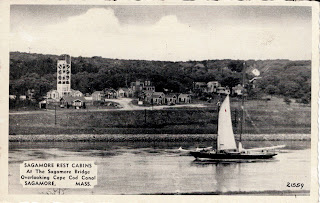
Sagamore Rest Cabins

Sagamore Rest Cabins, Cape Cod, Massachusetts

Sagamore Rest Cabins was a lodging establishment located in Cape Cod overlooking the Cape Cod Canal, about a 1000 feet off the main road. Their advertising specifically stated "Gentile Clientele" meaning No Jews! (see the story here).

Deltiology


Artist: Taken from a photograph
Publisher: H. K. Skinner & Son, Pearl River, New York
Printer: Dexter Press Incorporated
Date: White Border era 1915-1930. As the printer was Dexter Press which only was only established in 1920, we can say that this was from 1920 to 1930.
Printing TypeLithograph


Rarity: ☝ Common

Thursday, April 11, 2024

The dawn of the 20th century


Not much can be identified about this postcard. It is entitled "at the Dawn of the 20th century"

The Geneva printer Louis Bron, future mayor of the Faubourg de Saint-Gervais, took up the title of a theatrical review published from 1878 to 1879 in October 1894. For the drawings, he secured the collaboration of Polyte, alias Albert Gantner, then Noël Fontanet and René Pellarin, known as Pellos.

The postcard image shows a "Stereotypes of Jews" where a seemingly Jewish man, is trying to bribe a woman.

Deltiology


Artist: Polyte
Publisher: Gauss magazine
Printer: Switzerland
Date: 1900
Printing Type:


Rarity: Unseen

Wednesday, April 3, 2024

Shylock


"The Merchant of Venice" is a play by William Shakespeare that has sparked much debate over its portrayal of Jews and the character of Shylock, a Jewish moneylender. The play is set in Venice, where Shylock lends money to Antonio, a Christian merchant, with the stipulation that if Antonio fails to repay, Shylock may take a pound of his flesh.

Antonio borrows the money for his friend Bassanio, who needs it to court the wealthy heiress, Portia. When Antonio's ships are lost at sea and he cannot repay the loan, Shylock insists on his bond. In court, Portia, disguised as a lawyer, argues that Shylock can take his pound of flesh but not a drop of blood, rendering the bond impossible to fulfill without killing Antonio, which is unlawful.

The play ends with Shylock being forced to convert to Christianity and losing his fortune. The treatment of Shylock has been interpreted as a reflection of the antisemitism prevalent in Shakespeare's time. The character has been variously portrayed as a villain or a sympathetic figure, and the play's depiction of Jews has been the subject of scholarly debate and differing interpretations in various productions throughout history.

The English phrase “a pound of flesh” originates the play “The Merchant of Venice. It refers to a demand for repayment, regardless of the cost or consequences to the debtor. Shylock, a Jewish moneylender, agrees to lend money to Antonio on the condition that if the loan is not repaid, Shylock is entitled to a pound of Antonio’s flesh. The phrase has come to symbolize an insistence on being repaid, even if the repayment will destroy or harm the debtor

The postcard image shows Shylock looking a bit evil.

Deltiology


Artist: Sydney Carter
Publisher: S. Hildesheimer & Company Limited
Printer: Bavaria
Date:
Printing Type: Lithography


Rarity: Common

Thursday, March 21, 2024

Joseph's coat

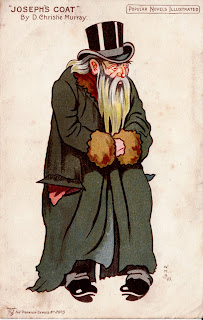
"Joseph's Coat" is a novel written by David Christie Murray, (1847–1907) was born in West Bromwich, Staffordshire, England. The novel was first published in 1880. While it shares its name with the biblical story of Joseph and his coat of many colors, the plot of Murray's novel is presumably not directly related to that biblical narrative.

Instead, "Joseph's Coat" is a social novel that deals with themes of identity, class, and society in late Victorian England. The story follows the life of Joseph Wilmot, a young man who faces various challenges and struggles as he navigates the complexities of English society. The novel explores Joseph's relationships, ambitions, and the societal pressures he encounters.

Apparently the title's reference to Joseph from the Bible is metaphorical rather than religious or ethnic. However, it's worth considering the historical context in which the novel was written. During the late 19th century, antisemitism was prevalent in Europe, including in England. Some authors of the time incorporated antisemitic stereotypes and sentiments into their works, reflecting the prejudices of the era.

The Illustration

The illustration does seem to show Jewish characteristics such as the huge nose and ears and the rather dirty looking coat, but perhaps that is my own view and not something intentional.

Deltiology


Artist: W. Milne Black
Publisher: William Lyon, Glasgow
Printer:
Date: 1903 (part of signature)
Printing Type:


Rarity: Common

#postcards #JewsAreDifferent

Thursday, September 21, 2023

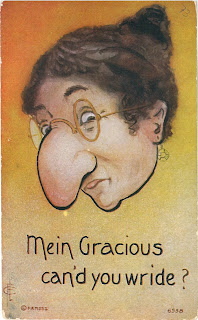
Mein gracious, can'd you wride

antisemitic postcard showing a woman with a huge nose and the sentiment 'mein gracious, can'd you wride'

A caricature of a woman with a huge Jewish nose which is out of propertion with her features. Also shows Yiddish accented English, 'mein gracious, can'd you wride'. This displays the stereotype of a Jew with a huge nose as well as not being able to speak English properly.

What is the Jewish nose or the Hooked nose

The term 'Jewish nose' or 'hooked nose' is a harmful stereotype perpetuating a perceived physical trait associated with some Jewish individuals, suggesting a prominent or curved nose shape. However, it's crucial to emphasize that stereotypes are inaccurate and offensive. Stereotypes only fuel prejudice, discrimination, and bias. Jewish people, like any other group, display a diverse range of physical characteristics. It's essential to promote understanding and respect for diversity rather than perpetuating harmful assumptions based on physical appearances. Stereotypes have no basis in science or fact and should be actively discouraged and challenged.

Deltiology

Artist: Frederick Leopold Cavally
Publisher: F.A. Moss
Printer:
Date: 1909

Part of the F.A Moss reminder series 6538

Rarity: ☝☝☝ less than ten seen by this blogger

#postcards #JewsAreDifferent #comic #JewishNose #jewNose

Tuesday, September 19, 2023

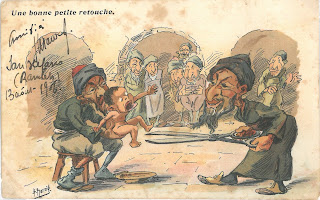
Circumcision - Just a little retouch

The postcard depicts a Jewish "mohel" about to give the Muslim baby boy a circumcision. The words in French, are just a little retouch. The Jew is shown with an evil glee and a huge pair of scissors and the baby is terrified.

Circumcision

Circumcision in Judaism, known as "brit milah" in Hebrew, is a religious ritual and significant ceremony within Jewish tradition. It involves the surgical removal of the foreskin from the penis of a male infant, typically on the eighth day after birth. This practice is based on the commandment given in the Torah, specifically in the book of Genesis (17:10-14), where God instructs Abraham to circumcise himself and all male members of his household as a sign of the covenant between God and the Jewish people.
The brit milah ceremony is a joyous occasion where family and friends gather to celebrate the child's entrance into the Jewish community. A qualified individual, known as a mohel, performs the circumcision according to Jewish law and tradition. The event often includes prayers, blessings, and a festive meal. The act of circumcision symbolizes a covenant with God and is a fundamental aspect of Jewish identity and heritage.

Islam

In Islam, circumcision is known as "khitan" or "circumcision" in Arabic. It is a religious and cultural practice that involves the surgical removal of the foreskin from the penis of a male child. While circumcision is not explicitly mentioned in the Quran, it is strongly encouraged and widely practiced in Islamic tradition based on the teachings and practices of the Prophet Muhammad (peace be upon him), known as the Sunnah.

Circumcision is seen as a sign of cleanliness, purity, and obedience to God's command. It is often performed within the first few years of a boy's life, although the exact age and manner of the procedure can vary based on cultural and regional practices. Many Muslim-majority countries have specific traditions and ceremonies associated with circumcision, and it is viewed as an important rite of passage for male individuals in the Islamic community.

Deltiology


Artist: Édouard Herzig
Publisher:
Printer:
Date: 1926 (postmark)
Printing Type:


Rarity: Common

#postcards #JewsAreDifferent

Wednesday, September 13, 2023

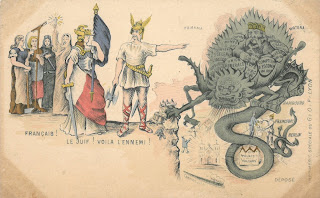
Jews are the enemy

Antisemitic postcard saying that Jews are the enemy
The postcard bears the inscription, "France! The Jew! Here is the enemy!" It is an anti-Semitic illustration portraying a grotesque Jewish figure entering France, following its destruction of other European nations, or control over other nations. This monstrous caricature controls both the press and the justice system, while clutching sacks of money. Above its eyes, the word "Talmud" is prominently featured. The postcard depicts various so-called assets associated with Jews, including ownership of railroads, with city names encircling the monstrous figure, and a Jewish figure above, holding bags representing various companies. There is also an inscription for "Panama". What had Panama got to do with the "Jews are the enemy" statement?

The Panama Scandal of 1893

The Panama Canal Scandal marked a notorious episode within the French Third Republic, resulting in significant losses for many investors. In 1893, the revelation of corruption involving prominent political and financial figures within the Panama Canal Company led to a distressing period where some publishers unjustly scapegoated Jewish individuals. This came on the heels of the Dreyfus Affair which erupted a year later.

On February 4, 1889, the Tribunal Civil de la Seine issued an order for the liquidation of the Panama Canal Company in Paris. Work on the Panama Canal project came to a halt, and a court-appointed liquidator undertook the task of preserving the existing infrastructure, tools, and machinery. Over the following years, substantial losses were incurred due to the humid and warm climate of the Panama area. The French government, reluctant to accept takeover offers from various American companies it deemed inadequate, prolonged the liquidation process.

The extent of the bankruptcy became evident by 1892, leaving approximately 800,000 French citizens in financial ruin. These citizens had invested in the company's stocks, bonds, and shares.

In 1893, numerous ministers faced allegations from French nationalists, accusing them of accepting bribes from Ferdinand de Lesseps in 1888 to facilitate the stock issuance. This led to a corruption trial against Lesseps and his son Charles. Members of parliament were implicated in receiving bribes from the Panama Canal Company to conceal its true financial status. 

This scandal left an indelible mark on the development of French antisemitism, as it involved two individuals of German-Jewish heritage, Baron Jacques Reinach and Cornelius Herz. While they were not part of the bribed Parliament members or the company's board, they were entrusted with the distribution of the bribe funds. Reinach operated covertly as a financial adviser to the government and managed its interactions with the Panama Company. Herz, on the other hand, was Reinach's contact within the radical faction, but his duplicitous dealings and blackmail ultimately drove Reinach to take his own life. Source: https://en.wikipedia.org/wiki/Panama_scandals

Deltiology


Artist: Possibly: Adolphe Willette
Publisher: The Grand Orient de France (GODF), Lyon, France
Printer:
Date: Circa 1900

Rarity: ☝☝☝☝ Less than three seen
#postcards #stereotype #JewishBehavior #JewsAreTheEnemy

Statcounter