Showing posts with label Nose. Show all posts

Thursday, September 25, 2025

Highlander frae Jee-rusalem

Antisemitic postcards from the early 20th century provide a disturbing window into how Jewish stereotypes were normalized in popular culture. The 1909 Bamforth comic postcard exemplifies how these harmful caricatures were mass-produced and distributed as "entertainment," contributing to the perpetuation of antisemitic attitudes across society.

The 1909 Bamforth Postcard: Visual Analysis

Front Image: Dissecting the Antisemitic Imagery

The front of this Bamforth postcard presents a grotesque caricature that embodies multiple antisemitic stereotypes prevalent in 1909. The illustration features an exaggerated male figure with distinctly antisemitic visual tropes:

  • Exaggerated facial features: The oversized hooked nose was a common antisemitic stereotype falsely linked to Jewish people.
  • Clothing and appearance: The figure is dressed in clothing suggesting both poverty and merchant activity, reinforcing stereotypes about Jewish economic roles.
  • Body language and posture: The character's stance and expression convey cunning or scheming, echoing harmful stereotypes about Jewish character.

Deltiology

  • Publisher identification: Bamforth & Co., a leading British postcard publisher of comic and novelty cards.
  • Series information: This postcard belonged to a broader series, showing systematic production rather than isolated creation.
  • Published: 1909

Historical Context: Britain in 1909

The Golden Age of Postcards

The period from 1900–1915 is often called the "Golden Age of Postcards." During this time:

  • Postcard collecting became a widespread hobby across social classes.
  • Publishers produced millions of cards on nearly every topic imaginable.
  • Comic postcards were especially popular, often relying on ethnic and social stereotypes.
  • Antisemitic imagery was unfortunately common and considered acceptable by society.

British Antisemitism in the Edwardian Era

In 1909, Britain experienced:

  • Increased Jewish immigration from Eastern Europe after pogroms.
  • Growing tensions about immigration and economic competition.
  • The normalization of antisemitic attitudes in popular culture.
  • A lack of legal protections against discriminatory content.

The Business of Stereotypes

For publishers like Bamforth, antisemitic postcards were:

  • Profitable products with an eager market.
  • Regarded as socially acceptable "humor."
  • Often part of larger series targeting different ethnic groups.
  • Normalized further by mass production and circulation.

The Role of Postcards in Normalizing Antisemitism

Mass Media and Social Attitudes

Postcards functioned as an early form of mass media that:

  • Crossed class and geographic boundaries.
  • Reinforced prejudices through repetition.
  • Framed antisemitic imagery as humorous or harmless.
  • Encouraged the casual acceptance of discrimination.

The Cumulative Effect

Widespread circulation of such postcards:

  • Normalized antisemitic stereotypes in daily life.
  • Targeted Jewish individuals for prejudice and ridicule.
  • Created a cultural climate that paved the way for later persecution.
  • Shows how “entertainment” can perpetuate serious social harm.

Collecting and Understanding Today

The Importance of Historical Documentation

Today, these postcards serve as:

  • Educational tools that reveal historical antisemitism.
  • Research material for scholars studying prejudice.
  • Warning signs of how hatred becomes normalized.
  • Context for understanding the roots of modern antisemitism.

Ethical Considerations for Collectors

Collectors should:

  • Handle materials with sensitivity.
  • Understand the historical harm they represent.
  • Prioritize education over profit.
  • Acknowledge their real-world impact on Jewish communities.

The Legacy of Antisemitic Postcards

From Postcards to Propaganda

The casual antisemitism of 1909 postcards foreshadowed:

  • More organized antisemitic propaganda in later decades.
  • The escalation from prejudice to legal discrimination.
  • The role of media in dehumanizing Jewish people.
  • The dangerous progression from stereotypes to persecution.

Lessons for Today

This Bamforth postcard illustrates:

  • How easily harmful stereotypes spread in society.
  • The power of mass media in shaping attitudes.
  • The need to recognize and challenge prejudice early.
  • The importance of vigilance against antisemitism today.

Frequently Asked Questions (FAQ)

What made Bamforth postcards so popular in 1909?

Bamforth postcards were affordable, widely available, and reflected contemporary humor. Skilled artists and efficient production made them accessible across social classes during the postcard craze of the early 1900s.

Were antisemitic postcards legal in Britain in 1909?

Yes. Britain had no hate speech or anti-discrimination laws in 1909, so publishers could freely produce and distribute antisemitic content.

How common were Jewish stereotype postcards in the early 1900s?

They were unfortunately very common. Major publishers included antisemitic cards in their comic series, sold widely in Britain and across Europe.

What happened to Bamforth & Co.?

Bamforth & Co. continued operating into the 20th century. While they later moved away from overtly antisemitic content, the company remained a major producer of comic postcards.

Why is it important to study these offensive postcards today?

Studying them helps us understand how prejudice was normalized, provides evidence of antisemitism in history, and highlights the power of media to spread harmful stereotypes. This knowledge is essential for preventing future repetition.

How should museums and collectors handle antisemitic postcards?

They should provide context, use the material for education, and present it with sensitivity to the harm it caused, rather than as curiosities or entertainment.

Conclusion: Understanding History to Prevent Repetition

The 1909 Bamforth postcard is more than a historical curiosity—it is evidence of how antisemitic stereotypes permeated popular culture as mass entertainment. Studying such artifacts reveals how prejudice operates and spreads across society.

These postcards remind us that antisemitism was not confined to extremists; it was woven into everyday life. Its casual nature made it especially dangerous, laying cultural groundwork for future persecution.

Friday, July 26, 2024

Belief me

Belief Me – A.H. Jewish stereotype postcard

Author: Lawrence –

Location: Chicago, Illinois, USA

These four postcard variants, and probably more exist, all showing the same caricatured image, were printed across different years. Each reflects the commercial humor and visual style of the early postcard era, with subtle differences in production or captioning.

Series overview: The caption Belief Me appears on a group of early 1900s postcards credited as Copyright 1905 – A.H., likely tied to Alfred Holzman of Chicago. Designs exist as paper chromolithographs and as leather postcards burned by pyrography. Numbering of 73, in the lower margin places them, in a commercial humor series from the undivided back era.

Antisemitic Stereotypes Depicted

This postcard features a number of classic antisemitic stereotypes that were commonly used in early 20th-century European and American visual culture. The image and text employ caricature and symbolism to perpetuate harmful, false depictions of Jews, which were typical in period postcards and other forms of popular media.
  • Physical Caricature: The man is depicted with exaggerated facial features—large nose, thick lips, and round spectacles—traits that have been used in antisemitic iconography to mock Jewish appearance.
  • Attire: The figure wears a beard and a skullcap, suggesting the stereotype of the "Eastern European Jew" or Orthodox Jew, feeding into the imagery used to otherize Jewish communities.
  • Jewelry: The prominent jewel or medallion on the chest can be linked to stereotypes about Jews and wealth or greed, with the radiant lines around the stone possibly suggesting ostentatiousness or material obsession.
  • Smoking Cigar: The smoking cigar, often seen in antisemitic illustrations, can be intended to indicate self-indulgence, showiness, or a louche lifestyle.
  • Gestures: The open-handed gesture might be interpreted as a sign of exaggerated speech or persuasion, often used to suggest untrustworthiness or theatricality in antisemitic portrayals.
  • Text (“Belief Me”): The pseudo-Germanic phrase “Belief Me,” intentionally misspelled, mocks Jewish accent or manner of speaking, a trope found in English-language antisemitic humor at the time.

Production notes

  • Credit line in first postcard reads Copyright 1905 – A.H. with a small series number of 73.
  • Printed as chromolithography on paper and as leather postcards using pyrography on deer hide.

Why classify Belief Me as antisemitic?

The humor is built from caricatured features, religious costume cues, wealth markers, and mock accent spelling that invite readers to see Jewishness as comic and untrustworthy.

Belief Me postcard, 1905
Variant 1: Original chromolithograph edition (1905)
Variant 2
Variant 2: Leather pyrography version (1905)

Variant 3
Variant 3: Leather postcard with green shirt (1905)
Variant 4
Variant 4: No copyright (1907), divided back period

Thursday, March 21, 2024

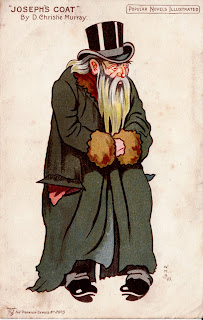
Joseph's coat

"Joseph's Coat" is a novel written by David Christie Murray, (1847–1907) was born in West Bromwich, Staffordshire, England. The novel was first published in 1880. While it shares its name with the biblical story of Joseph and his coat of many colors, the plot of Murray's novel is presumably not directly related to that biblical narrative.

Instead, "Joseph's Coat" is a social novel that deals with themes of identity, class, and society in late Victorian England. The story follows the life of Joseph Wilmot, a young man who faces various challenges and struggles as he navigates the complexities of English society. The novel explores Joseph's relationships, ambitions, and the societal pressures he encounters.

Apparently the title's reference to Joseph from the Bible is metaphorical rather than religious or ethnic. However, it's worth considering the historical context in which the novel was written. During the late 19th century, antisemitism was prevalent in Europe, including in England. Some authors of the time incorporated antisemitic stereotypes and sentiments into their works, reflecting the prejudices of the era.

The Illustration

The illustration does seem to show Jewish characteristics such as the huge nose and ears and the rather dirty looking coat, but perhaps that is my own view and not something intentional.

Deltiology


Artist: W. Milne Black
Publisher: William Lyon, Glasgow
Printer:
Date: 1903 (part of signature)
Printing Type:


Rarity: Common

#postcards #JewsAreDifferent

Thursday, September 21, 2023

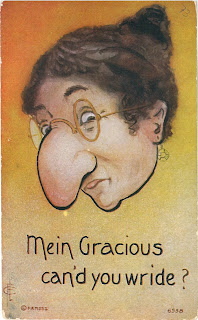
Mein gracious, can'd you wride

antisemitic postcard showing a woman with a huge nose and the sentiment 'mein gracious, can'd you wride'

A caricature of a woman with a huge Jewish nose which is out of propertion with her features. Also shows Yiddish accented English, 'mein gracious, can'd you wride'. This displays the stereotype of a Jew with a huge nose as well as not being able to speak English properly.

What is the Jewish nose or the Hooked nose

The term 'Jewish nose' or 'hooked nose' is a harmful stereotype perpetuating a perceived physical trait associated with some Jewish individuals, suggesting a prominent or curved nose shape. However, it's crucial to emphasize that stereotypes are inaccurate and offensive. Stereotypes only fuel prejudice, discrimination, and bias. Jewish people, like any other group, display a diverse range of physical characteristics. It's essential to promote understanding and respect for diversity rather than perpetuating harmful assumptions based on physical appearances. Stereotypes have no basis in science or fact and should be actively discouraged and challenged.

Deltiology

Artist: Frederick Leopold Cavally
Publisher: F.A. Moss
Printer:
Date: 1909

Part of the F.A Moss reminder series 6538

Rarity: ☝☝☝ less than ten seen by this blogger

#postcards #JewsAreDifferent #comic #JewishNose #jewNose

Tuesday, August 15, 2023

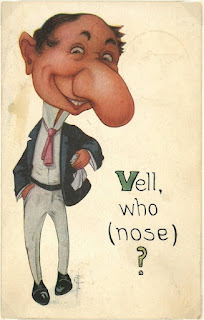
Vel, who nose?

antisemitic postcard showing a man with a huge nose

A caricature of a Jewish nose which is huge in comparison to the face. Also shows Yiddish accented English, a play on "Well, who knows?"

What is the Jewish nose or the Hooked nose

The term 'Jewish nose' or 'hooked nose' is a harmful stereotype perpetuating a perceived physical trait associated with some Jewish individuals, suggesting a prominent or curved nose shape. However, it's crucial to emphasize that stereotypes are inaccurate and offensive. Stereotypes only fuel prejudice, discrimination, and bias. Jewish people, like any other group, display a diverse range of physical characteristics. It's essential to promote understanding and respect for diversity rather than perpetuating harmful assumptions based on physical appearances. Stereotypes have no basis in science or fact and should be actively discouraged and challenged.

Deltiology


Artist: Frederick Leopold Cavally
Publisher:
Printer:
Date: Postmarked 1912


Rarity: ☝☝☝ less than ten seen by this blogger

#postcards #JewsAreDifferent #comic

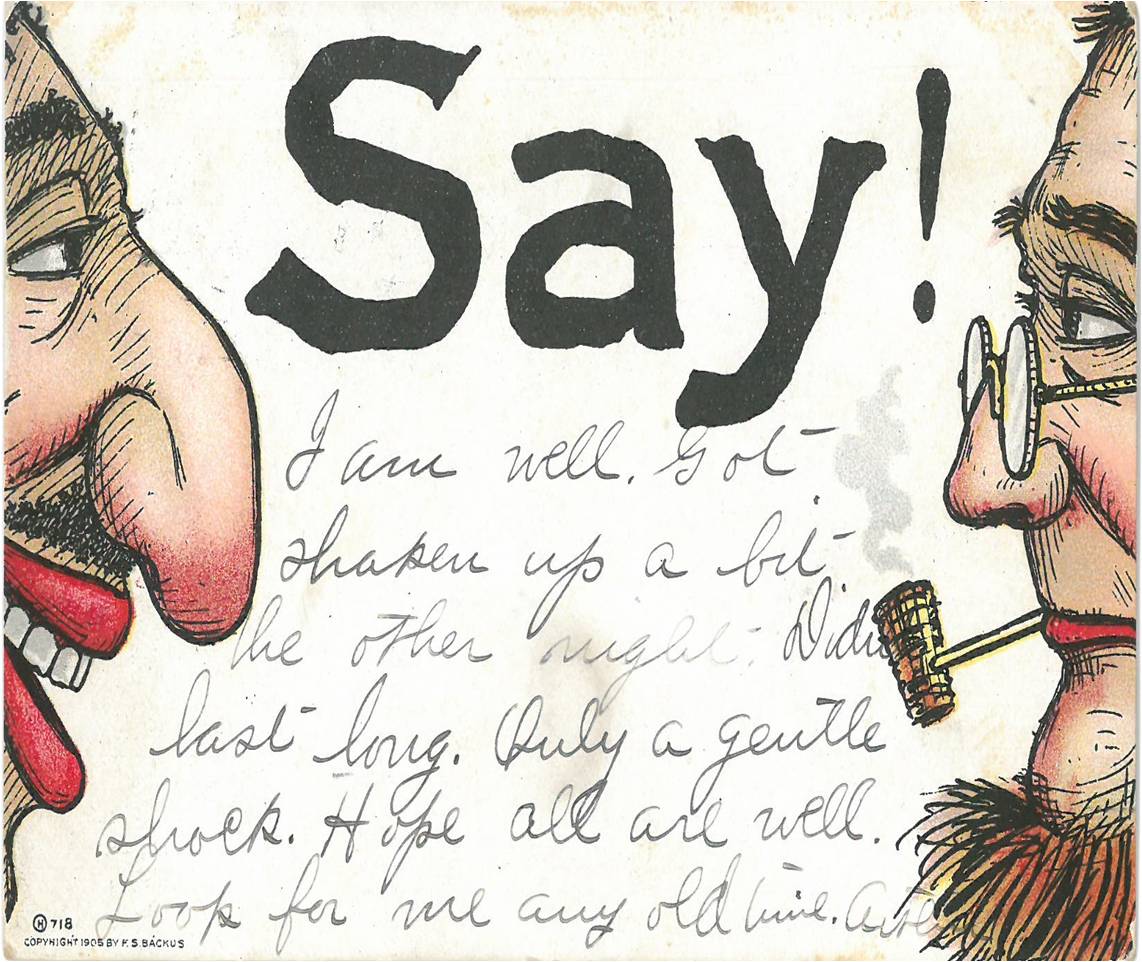
Say!

Antisemitic postcard showing a man with a hooked nose

Shows the ultimate stereotype of the Jewish nose. It is a hooked nose with a downward turn of the tip of the nose. The 'Jewish nose' was singled out as a hostile caricature of Jews in mid-13th century Europe. Since the 18th century it has become the rule when showing what a Jew looks like.

What is the Jewish nose or the Hooked nose

The term 'Jewish nose' or 'hooked nose' is a harmful stereotype perpetuating a perceived physical trait associated with some Jewish individuals, suggesting a prominent or curved nose shape. However, it's crucial to emphasize that stereotypes are inaccurate and offensive. Stereotypes only fuel prejudice, discrimination, and bias. Jewish people, like any other group, display a diverse range of physical characteristics. It's essential to promote understanding and respect for diversity rather than perpetuating harmful assumptions based on physical appearances. Stereotypes have no basis in science or fact and should be actively discouraged and challenged.

Deltiology


Artist:
Publisher: F. S. Backus
Printer:
Date: 1905
From series 718 of “Say!” Each postcard in the series showed two different stereotypes.

Rarity: ☝☝☝☝ less than three seen by this blogger

Statcounter