Thursday, March 21, 2024

Joseph's coat

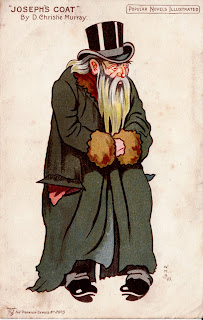
"Joseph's Coat" is a novel written by David Christie Murray, (1847–1907) was born in West Bromwich, Staffordshire, England. The novel was first published in 1880. While it shares its name with the biblical story of Joseph and his coat of many colors, the plot of Murray's novel is presumably not directly related to that biblical narrative.

Instead, "Joseph's Coat" is a social novel that deals with themes of identity, class, and society in late Victorian England. The story follows the life of Joseph Wilmot, a young man who faces various challenges and struggles as he navigates the complexities of English society. The novel explores Joseph's relationships, ambitions, and the societal pressures he encounters.

Apparently the title's reference to Joseph from the Bible is metaphorical rather than religious or ethnic. However, it's worth considering the historical context in which the novel was written. During the late 19th century, antisemitism was prevalent in Europe, including in England. Some authors of the time incorporated antisemitic stereotypes and sentiments into their works, reflecting the prejudices of the era.

The Illustration

The illustration does seem to show Jewish characteristics such as the huge nose and ears and the rather dirty looking coat, but perhaps that is my own view and not something intentional.

Deltiology


Artist: W. Milne Black
Publisher: William Lyon, Glasgow
Printer:
Date: 1903 (part of signature)
Printing Type:


Rarity: Common

#postcards #JewsAreDifferent

Wednesday, March 20, 2024

William Lyon, Glasgow, Scotland

William Lyon


Based in Glasgow, Scotland.


Born in 1845 in Troon, Ayrshire, William Lyon displayed early artistic talent. In 1867, following his marriage, he relocated to Glasgow. By 1868, he was listed as a stationer in the Post Office directory, expanding his services in 1869 to include die-sinking and crest embossing.

By 1871, Lyon's business had flourished, employing a staff of one man and nine girls in Sauchiehall Street. Over the years, Lyon's stationery enterprise continued to evolve. By 1885, he had established a presence with a shop at 389 Sauchiehall Street, a printing factory across the street at 474 Sauchiehall Street, and a retail branch in the Argyll Arcade.

Notably, Lyon revolutionized the stationery industry by introducing private Christmas cards, departing from the traditional slip-inset method. This innovation propelled demand, necessitating the expansion of Lyon's operations with the opening of his factory.

In 1888, Lyon showcased his diverse offerings, including visiting cards, at an exhibition, boasting a three-minute production service. By 1898, Lyon's commitment to progress was evident with the adoption of telephone communication at his factory.

Continuing to expand, Lyon operated four shops by 1900, strategically located across prime retail areas in Glasgow. In 1905, Lyon further consolidated his presence by establishing a shop at 177 Sauchiehall Street, later acquiring adjacent premises to form Lyon Corner.

By 1910, Lyon restructured his business as Lyon Ltd, entrusting its management to his eldest sons. Tragically, William Lyon passed away in 1913, leaving behind a legacy of innovation and entrepreneurial spirit.

In 1922, Lyon Ltd showcased its diverse range of products at the British Industries Fair, highlighting its premier series of cards, invitations, stationery, and silk pincushions, reflecting Lyon's enduring influence on the stationery and publishing industry.

For more information, see https://undividedbackpostcard.com/directory-l/#Lyon

Check these postcards from this publisher:
Joseph's coat
Joseph's Coar

W Milne Black

Not much is known about this Glasgow landscape artist. W Milne Black was known to have designed some comic postcards.

Thursday, September 21, 2023

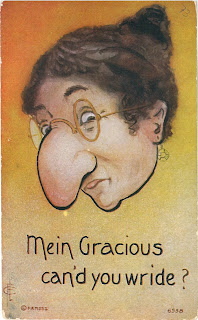
Mein gracious, can'd you wride

antisemitic postcard showing a woman with a huge nose and the sentiment 'mein gracious, can'd you wride'

A caricature of a woman with a huge Jewish nose which is out of propertion with her features. Also shows Yiddish accented English, 'mein gracious, can'd you wride'. This displays the stereotype of a Jew with a huge nose as well as not being able to speak English properly.

What is the Jewish nose or the Hooked nose

The term 'Jewish nose' or 'hooked nose' is a harmful stereotype perpetuating a perceived physical trait associated with some Jewish individuals, suggesting a prominent or curved nose shape. However, it's crucial to emphasize that stereotypes are inaccurate and offensive. Stereotypes only fuel prejudice, discrimination, and bias. Jewish people, like any other group, display a diverse range of physical characteristics. It's essential to promote understanding and respect for diversity rather than perpetuating harmful assumptions based on physical appearances. Stereotypes have no basis in science or fact and should be actively discouraged and challenged.

Deltiology

Artist: Frederick Leopold Cavally
Publisher: F.A. Moss
Printer:
Date: 1909

Part of the F.A Moss reminder series 6538

Rarity: ☝☝☝ less than ten seen by this blogger

#postcards #JewsAreDifferent #comic #JewishNose #jewNose

Tuesday, September 19, 2023

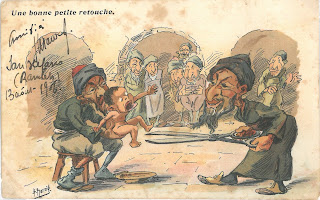
Circumcision - Just a little retouch

The postcard depicts a Jewish "mohel" about to give the Muslim baby boy a circumcision. The words in French, are just a little retouch. The Jew is shown with an evil glee and a huge pair of scissors and the baby is terrified.

Circumcision

Circumcision in Judaism, known as "brit milah" in Hebrew, is a religious ritual and significant ceremony within Jewish tradition. It involves the surgical removal of the foreskin from the penis of a male infant, typically on the eighth day after birth. This practice is based on the commandment given in the Torah, specifically in the book of Genesis (17:10-14), where God instructs Abraham to circumcise himself and all male members of his household as a sign of the covenant between God and the Jewish people.
The brit milah ceremony is a joyous occasion where family and friends gather to celebrate the child's entrance into the Jewish community. A qualified individual, known as a mohel, performs the circumcision according to Jewish law and tradition. The event often includes prayers, blessings, and a festive meal. The act of circumcision symbolizes a covenant with God and is a fundamental aspect of Jewish identity and heritage.

Islam

In Islam, circumcision is known as "khitan" or "circumcision" in Arabic. It is a religious and cultural practice that involves the surgical removal of the foreskin from the penis of a male child. While circumcision is not explicitly mentioned in the Quran, it is strongly encouraged and widely practiced in Islamic tradition based on the teachings and practices of the Prophet Muhammad (peace be upon him), known as the Sunnah.

Circumcision is seen as a sign of cleanliness, purity, and obedience to God's command. It is often performed within the first few years of a boy's life, although the exact age and manner of the procedure can vary based on cultural and regional practices. Many Muslim-majority countries have specific traditions and ceremonies associated with circumcision, and it is viewed as an important rite of passage for male individuals in the Islamic community.

Deltiology


Artist: Édouard Herzig
Publisher:
Printer:
Date: 1926 (postmark)
Printing Type:


Rarity: Common

#postcards #JewsAreDifferent

Wednesday, September 13, 2023

Jews are the enemy

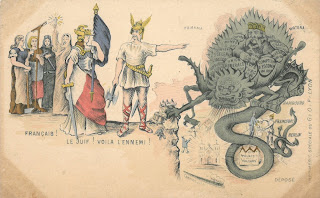
Antisemitic postcard saying that Jews are the enemy
The postcard bears the inscription, "France! The Jew! Here is the enemy!" It is an anti-Semitic illustration portraying a grotesque Jewish figure entering France, following its destruction of other European nations, or control over other nations. This monstrous caricature controls both the press and the justice system, while clutching sacks of money. Above its eyes, the word "Talmud" is prominently featured. The postcard depicts various so-called assets associated with Jews, including ownership of railroads, with city names encircling the monstrous figure, and a Jewish figure above, holding bags representing various companies. There is also an inscription for "Panama". What had Panama got to do with the "Jews are the enemy" statement?

The Panama Scandal of 1893

The Panama Canal Scandal marked a notorious episode within the French Third Republic, resulting in significant losses for many investors. In 1893, the revelation of corruption involving prominent political and financial figures within the Panama Canal Company led to a distressing period where some publishers unjustly scapegoated Jewish individuals. This came on the heels of the Dreyfus Affair which erupted a year later.

On February 4, 1889, the Tribunal Civil de la Seine issued an order for the liquidation of the Panama Canal Company in Paris. Work on the Panama Canal project came to a halt, and a court-appointed liquidator undertook the task of preserving the existing infrastructure, tools, and machinery. Over the following years, substantial losses were incurred due to the humid and warm climate of the Panama area. The French government, reluctant to accept takeover offers from various American companies it deemed inadequate, prolonged the liquidation process.

The extent of the bankruptcy became evident by 1892, leaving approximately 800,000 French citizens in financial ruin. These citizens had invested in the company's stocks, bonds, and shares.

In 1893, numerous ministers faced allegations from French nationalists, accusing them of accepting bribes from Ferdinand de Lesseps in 1888 to facilitate the stock issuance. This led to a corruption trial against Lesseps and his son Charles. Members of parliament were implicated in receiving bribes from the Panama Canal Company to conceal its true financial status. 

This scandal left an indelible mark on the development of French antisemitism, as it involved two individuals of German-Jewish heritage, Baron Jacques Reinach and Cornelius Herz. While they were not part of the bribed Parliament members or the company's board, they were entrusted with the distribution of the bribe funds. Reinach operated covertly as a financial adviser to the government and managed its interactions with the Panama Company. Herz, on the other hand, was Reinach's contact within the radical faction, but his duplicitous dealings and blackmail ultimately drove Reinach to take his own life. Source: https://en.wikipedia.org/wiki/Panama_scandals

Deltiology


Artist: Possibly: Adolphe Willette
Publisher: The Grand Orient de France (GODF), Lyon, France
Printer:
Date: Circa 1900

Rarity: ☝☝☝☝ Less than three seen
#postcards #stereotype #JewishBehavior #JewsAreTheEnemy

Monday, September 11, 2023

Douglas Manor, a restricted community

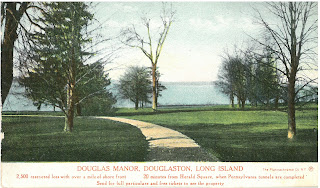
Douglas Manor was a restricted area, meaning off limits to Jews

Douglas Manor, Douglaston, Long Island 

In 1906 the Rickert-Finlay Realty Company bought land from George Douglas, a Scottish ship builder and established Douglas Manor which was to be an exclusive enclave (early deed-restricted suburb). This was known as a restricted community (see the story here).

The company boasted 2500 restricted lots, meaning no Jews (and other minorities). The area was planned according to cooperative ownership of the mile-long waterfront that they had purchased. The New York Times of April 15, 1906, reported that in the first four weeks after putting Douglas Manor lots for sale, they sold off 1386 lots, showing that the restricted idea had merit.

Deltiology


Artist: Taken from a photograph
Publisher: The Platinachrome Co, New York
Printer:
Date: 1906
Printing Type: Lithograph


Rarity: ☝☝☝☝ Less than three seen
Source: "Douglaston-Little neck" by Jason D.Antos


Statcounter